
Carrying Revolutionary Memory Forward
Haitian proverbs, okra, and the art of collective tending

“Yon sèl dwèt pa manje kalalou.” One finger cannot eat okra alone.
“Lè rasin pyebwa a pouri, branch yo pa ka rete vèt.” When the roots of the tree rot, the branches cannot stay green.

Every year on May 18, Haitians around the world celebrate Haitian Flag Day. For many people it is a celebration of pride, memory, resistance, beauty, language, and collective becoming. It is a moment in which an entire people reaches back across more than two centuries to touch something that has never stopped being sacred: the flag that was born from revolution, from solidarity, from the radical knowing that freedom belongs to everyone or it belongs to no one.
The story of the Haitian flag begins in 1803 at the Congress of Arcahaie, where Haitian revolutionary leaders made a decision so symbolic it still echoes through history. Jean Jacques Dessalines took the French tricolor and tore out the white center, while Catherine Flon sewed together the remaining blue and red bands to create what would become the flag of revolutionary Haiti. The white was removed deliberately because it represented the colonial power that had enslaved and brutalized an entire population. What remained, blue and red bound together, symbolized the unity of Black Haitians and those of mixed heritage, joined in a collective struggle toward freedom, liberation, and the building of a new nation rooted in the knowing that dignity belonged to all people.
On January 1, 1804, Haiti declared independence, becoming the first Black republic in the world, the first nation born from a successful slave revolution in all of human history. May 18 honors not just a piece of cloth but the philosophy sewn into it: that what is whole is stronger than what is divided, that no one people, no one class, no one finger, can sustain what life requires alone.
This remembrance that flows through my blood anchors me in the sacred work I do. If it’s one thing for certain, Haitians have a proverb for literally EVERYTHING and they are a rich language on their own. So I want to share with y’all two of these proverbs that come to mind that carry the full weight of the bolded philosophy. They are the lens through which this essay moves.
One Finger Cannot Eat Okra Alone
Yon sèl dwèt pa manje kalalou.

I have a love affair with Okra and this proverb is so beautiful in its simplicity and potency. Okra teaches before anyone explains it. You try to hold it with one finger and it slips away, slick with its own nature, refusing the logic of isolation. How honest. It was never designed for a single point of contact. The proverb shares about how reality behaves when we stop pretending it can be mastered alone. Some things only reveal their medicine when they are held by more than one hand.
This same pattern runs beneath everything alive. A forest is not just a gathering of trees but an underground braid of communication; roots and fungi exchanging nutrients, warnings, and care in a language older than words. What looks like independence above ground is actually sustained by relationship below it. Even revolutions follow this logic. In the struggle that became the Haitian Revolution, Jean-Jacques Dessalines and Catherine Flon moved within a field of coordination that colonial systems tried and failed to fracture. Unity wasn’t an option, it was the only way through.
The question I ask myself from the medicine of cousin Okra are: what am I still trying to hold alone that was designed for many hands? Where have I mistaken isolation for strength, when it is actually just strain? Okra reminds us gently, insistently, that many forms of life only make sense when they are shared.
When the Roots Rot, the Branches Cannot Stay Green
Lè rasin pyebwa a pouri, branch yo pa ka rete vèt
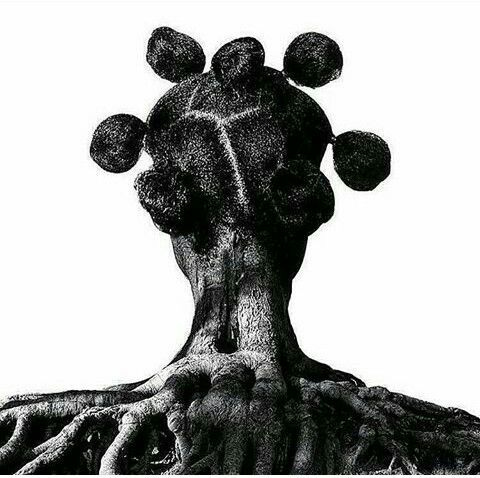
This proverb is the simplest one line masterclass on systems thinking. When the roots of the tree rot, the branches cannot stay green. Not will not. Cannot. The health of the parts is not separate from the health of the whole. It is determined by it.
This is what our dominant economic logic has spent generations trying to argue against. Imagine if someone came up to you and insisted that you can have thriving businesses in collapsing communities. Ludicrous right? That you can have healthy supply chains built on exploited labor. That you can have infinitely growing portfolios on a warming planet. That the branches can stay green even while the roots are rotting. But living systems do not negotiate with this logic. They simply demonstrate, over and over, that it is false.
Haiti has lived this proverb from both directions. The revolution that created the nation was an act of tending to roots: restoring the dignity, freedom, and self-determination of people whose very humanity had been denied. But in the centuries that followed, those roots were systematically attacked. France demanded reparations from Haiti for the loss of its enslaved population, a debt so crushing it shaped brutal challenges for generations. Trade embargoes, foreign interventions, and extractive debt arrangements drained resources from the country's foundations. The branches, meaning the ordinary Haitian people, have carried the weight of roots that these external forces refused to let heal. We see this happening globally time and time again.
And yet Haitian culture, Haitian art, Haitian cuisine, Haitian community, Haitian spiritual practice, and Haitian resilience have continued to grow. This is the remarkable thing. Even with compromised roots, the branches have held extraordinary life. Imagine what would be possible if the roots were allowed to be tended without distorted interventions.
Tending to the roots an reimagining the architecture of the economy and world we live in is what this season of sharing is about for me.
As I spend more time watching nature move in its native intelligence of cooperation, spiral, and flow and listening to the cultures that live in attunement with that, I keep receiving the same medicine in different forms: that creation is not something we impose on the world, but something we learn to enter into. A way of co creating with an intelligence that was here long before us and is still unfolding through us.
Tending the Roots as an Act Care & Participation
On building in a way that honors the whole system
If you are building something, a business, a project, a community, an institution, these proverbs are asking you specific questions. Not rhetorical ones. Actual ones that require answers.
Where are the roots of what you are building? Not just the financial foundations, though those matter, but the relational foundations. The cultural foundations. The ecological foundations. The ancestral knowledge and community trust that make your work possible at all. Are those roots being tended? Are they being fed? Or are they being quietly depleted so that the branches can look green a little longer? When you ask these questions and do the work to have these healthy and sustainably intact you realize that money is an inevitable byproduct. You realize that your capacity to world build is deeply expanded because you circulate many forms of value, not just one.
Who holds the whole hand with you? One finger cannot eat okra alone. This means your enterprise requires genuine collaboration, not the kind where one party sets all the terms and others comply, but the kind where different intelligences actually shape what gets built together. Whose wisdom is missing from your table? Whose knowledge has been undervalued in your field? What would it cost you to genuinely invite them in, and what would it cost you not to?
What does your success look like for the communities you are woven into? If your enterprise is thriving while the neighborhood around it is declining, or while the supply chain workers who feed it are struggling, or while the ecological systems it depends on are being depleted, then you are looking at the green branches and calling that success. But the roots are telling a different story. Living system will hold up a strong mirror of the truth.
Once I started really digging into these questions with myself and how I’m building Cultural Preservation Network, I realized that I had it in the name all along, NETWORK. I’ve been intentionally forming alliances with other social impact organizations and social change leaders (If this is you, say hi! You can reply to this post), and it’s been so beautiful & needed to be held by other folks doing this work and to hold. And I have been forming the sweetest alliances with the birds, the waters, the ducks, and the trees. Why limit ourselves to just human networks? Anyways, I’m off to go network in my backyard with the critters, animals, plants, and whoever else decides to some up. I’m excited to see who I meet today haha! Thank you so much for being here.
PS: If you haven’t planned on it already, I want to invite you to submit to our Open Call: Reimagining Economies in Service of Life, where we are using our collective creative currency to co-create and activate an archive that explores what a regenerative economy can look at feel like.
Until next time family,